


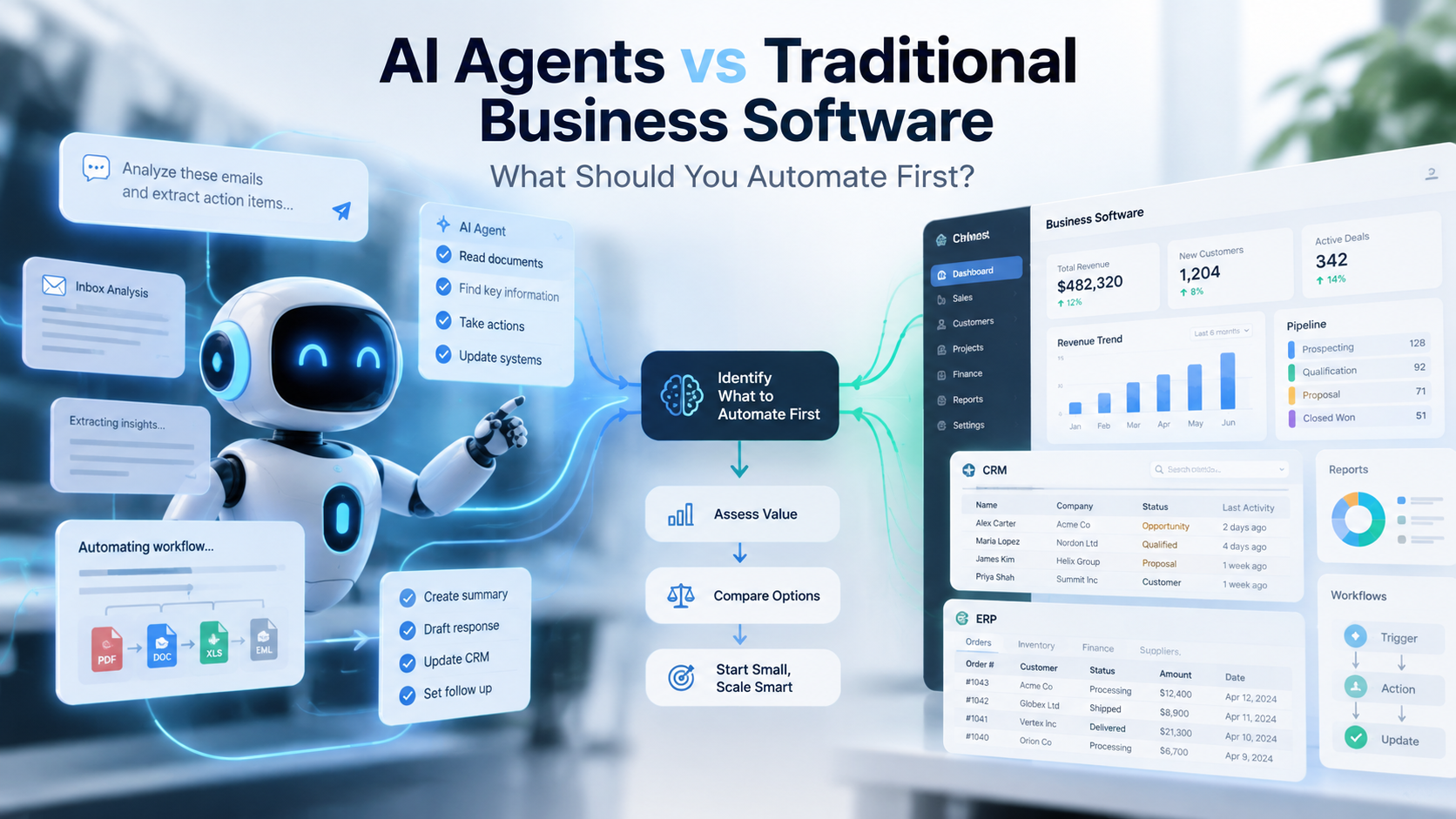
AI Agents vs Traditional Business Software: What Should You Automate First?
10 April 2026
Businesses have been automating processes for decades. ERP systems, CRM platforms, accounting tools, workflow software and custom applications already handle a large part of everyday operations.
Now AI agents are entering the same landscape.
The important question is no longer whether companies should use AI. The more practical question is: which processes should be automated with AI agents, and which should remain inside traditional business software?
The answer depends on the type of work being automated.
Traditional software works best when the process is predictable
Traditional business software is built around clearly defined rules.
If a process can be described as a predictable sequence of actions — input, validation, calculation, approval and output — conventional software usually remains the most reliable option.
Think about accounting systems, payroll, inventory management or payment processing.
These processes typically require strict logic, structured data and consistent execution. A salary calculation should not depend on interpretation. Neither should an invoice total or a stock balance.
Traditional software is especially effective when:
- rules are clearly defined;
- data is structured;
- the same workflow is repeated frequently;
- mistakes can have financial or regulatory consequences;
- outputs must be completely predictable.
In these situations, replacing existing systems with AI simply because AI is available rarely makes sense.
AI is more valuable when the problem is less structured.
AI agents are strongest when interpretation is required
AI agents are designed to work with information that traditional software finds difficult to process.
Emails, documents, conversations, requests and free-form text do not always follow predictable structures. Humans normally need to read the information, understand the context and decide what should happen next.
This is where AI agents become interesting.
An AI agent can, for example, receive a customer email, understand the request, search internal systems, prepare a response and create a task for an employee if further action is required.
Instead of following only fixed rules, the agent interprets information and uses context to determine the next step.
Typical use cases include:
- analysing incoming documents;
- qualifying sales leads;
- summarising customer conversations;
- preparing reports;
- extracting information from emails;
- answering internal knowledge questions;
- creating first drafts of proposals or responses;
- routing requests to the right department.
These tasks often consume significant employee time even though they do not necessarily require deep expertise.
Start with repetitive knowledge work
When companies begin exploring AI automation, the temptation is often to automate the most complex process first.
That is usually the wrong approach.
A better starting point is repetitive knowledge work.
Look for tasks where employees repeatedly read, copy, search, summarise or transfer information between systems.
For example, a sales team may receive dozens of inbound enquiries every week. Someone reads each message, checks whether the company fits the target profile, searches for additional information and enters the lead into the CRM.
An AI agent can support most of that workflow.
Similarly, a finance team may receive invoices and documents in different formats. Instead of manually extracting information, an AI-powered workflow can identify the relevant data and pass it into the existing accounting system.
The goal is not necessarily to replace the software already being used.
The goal is often to create an intelligent layer around it.
AI agents and traditional software should work together
The most effective automation architecture will likely combine both approaches.
Traditional software continues to act as the reliable system of record.
AI agents operate around those systems, helping people interact with information and automate tasks that previously required manual interpretation.
Imagine a CRM platform.
The CRM stores customers, opportunities and sales activity. That structured information belongs in traditional software.
But an AI agent could analyse incoming emails, update CRM records, summarise meetings and suggest follow-up actions.
The CRM remains the core system. The AI agent makes it easier to use.
This same model can apply to ERP platforms, helpdesk systems, document repositories and many other business applications.
A simple framework for deciding what to automate
Before building an AI agent, companies should ask a few practical questions.
Does the task happen frequently?
Does it consume meaningful employee time?
Does the task require understanding text, documents or conversations?
Can the output be reviewed before an important action is taken?
Can the agent securely access the required systems and data?
If the answer to most of these questions is yes, the process may be a good candidate for AI automation.
On the other hand, if the process involves strict calculations, deterministic logic or highly sensitive transactions, traditional software should usually remain responsible for the core execution.
Automate the right layer
AI agents are not replacing every business system.
They are creating a new automation layer between people and software.
Traditional systems will continue managing structured processes, transactions and business data. AI agents will increasingly handle the interpretation, coordination and information work surrounding those systems.
For most companies, the smartest strategy is therefore not to rebuild everything around AI.
It is to identify where employees still spend time moving information manually between people, documents and systems.
That is often where AI automation can deliver value first.
The companies that benefit most from AI will not necessarily be those that deploy the largest number of AI tools.
They will be the ones that identify the right processes to automate — and combine AI agents with the business software they already trust.

