


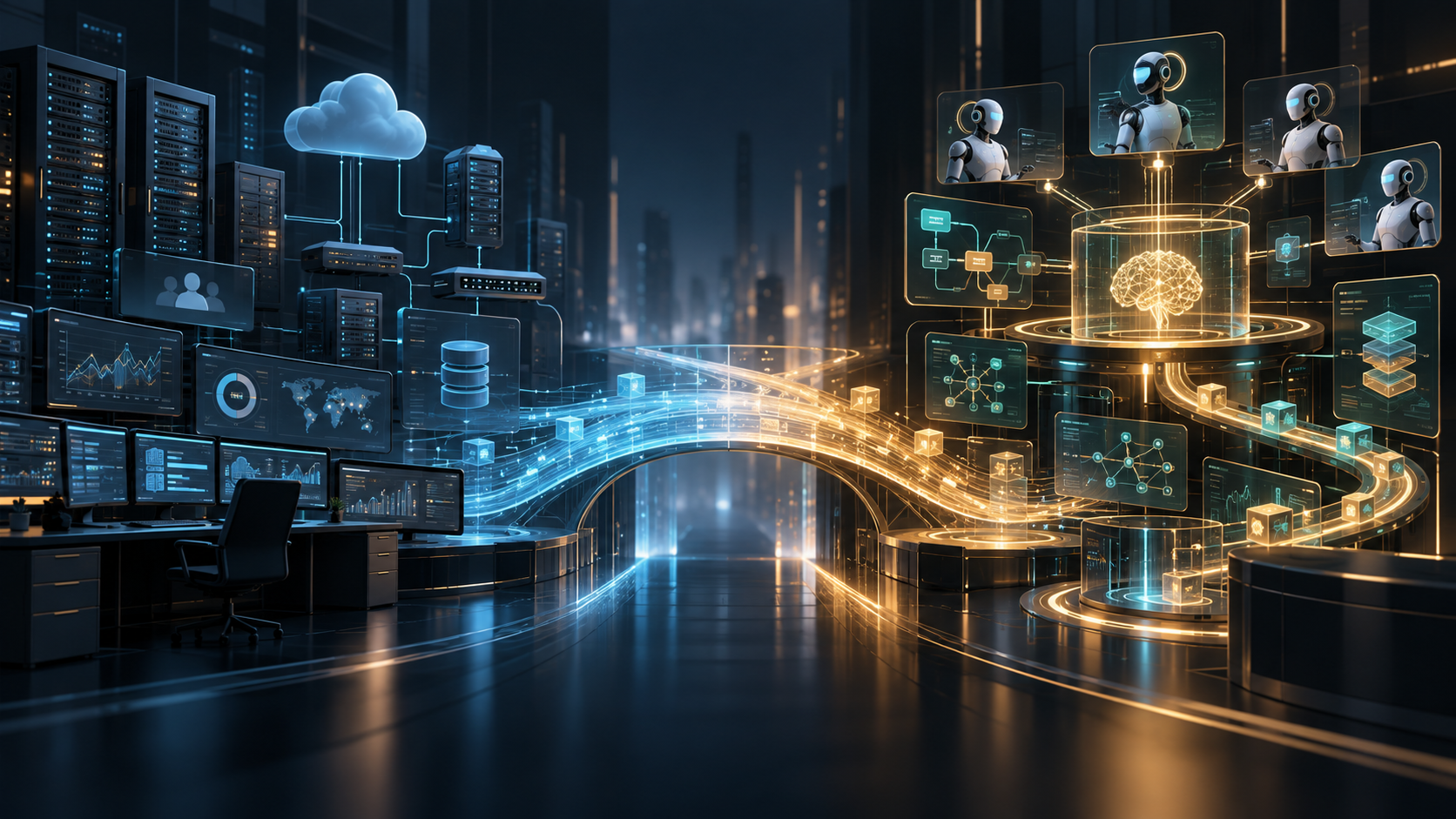
From IT Infrastructure to AI Infrastructure: The Next Managed Service
23 March 2026
For years, companies have relied on external partners to manage their IT environment.
Servers, cloud infrastructure, backups, cybersecurity, software updates and user support all became part of what businesses simply called their IT operations.
The logic was clear: technology needs continuous maintenance.
Now the same pattern is beginning to emerge with artificial intelligence.
As companies introduce AI assistants, agents, automations and integrations into daily operations, a new type of environment is taking shape.
Soon, we may talk not only about IT managed services, but also about AI managed services.
AI Is Becoming Part of Daily Operations
For many organisations, AI started as an experiment.
Employees tested ChatGPT. Marketing teams generated content. Developers used coding assistants. Managers tried AI for analysis and documentation.
But companies are now moving further.
AI agents can answer customer requests, analyse documents, prepare reports, search internal knowledge, update CRM systems and automate repetitive processes.
At that point, AI is no longer just a tool.
It becomes part of the company’s operational infrastructure.
And operational infrastructure needs maintenance.
Who Maintains the AI Environment?
Imagine a company using several AI automations.
One agent processes sales leads.
Another prepares internal reports.
Another supports customer service.
Another extracts data from documents.
Others connect internal systems and automate daily work.
Everything may work perfectly at first.
But then an API changes.
A model provider releases a new version.
A workflow stops producing the expected result.
The company changes its CRM.
Security requirements evolve.
Costs start increasing.
Someone then needs to understand how the entire AI environment works.
This is where AI operations start to become important.
AI Requires Continuous Maintenance
AI systems do not remain unchanged.
They depend on models, APIs, company data, permissions, integrations and changing business processes.
Companies may therefore need ongoing support for:
- AI agents and automations;
- prompts and system instructions;
- API integrations;
- access permissions;
- model selection;
- usage monitoring;
- cost optimisation;
- security controls;
- output quality;
- workflow improvements.
This begins to look very similar to traditional IT infrastructure management.
The key difference is that these systems may also analyse information, communicate with users and perform actions.
From IT Support to AI Support
Traditional IT support solves familiar technical problems.
A server goes offline.
A user loses access.
A backup fails.
Software needs an update.
AI support introduces different types of issues.
An agent may start misunderstanding requests.
An automation may send incorrect information.
A model update may change the quality of outputs.
AI usage costs may unexpectedly increase.
A business rule may change while the AI workflow remains unchanged.
The system may technically still be online.
But it may no longer work correctly.
That means monitoring AI is not only about uptime.
It is also about business outcomes.
Companies May Not Need an Internal AI Team
The same transition happened with traditional IT.
Many companies realised they did not need internal specialists for every technology they used.
Instead, they worked with managed service providers who maintained infrastructure and supported users.
AI may follow the same model.
Not every organisation needs its own internal AI department.
Instead, companies may increasingly work with external partners responsible for maintaining their AI environment.
That could include monitoring agents, improving workflows, maintaining integrations, controlling costs, reviewing security and implementing new automation opportunities.
The relationship therefore changes from a one-time AI project to a continuous service.
AI as a Managed Service
Today, many companies approach AI as a project.
Build a chatbot.
Automate a process.
Create an internal assistant.
Connect an AI model to existing software.
But once several AI solutions exist, businesses may need something more permanent.
Not simply:
“Build us an AI solution.”
But:
“Maintain and continuously improve our AI environment.”
This could become the AI equivalent of traditional IT managed services.
The Human Service Layer Still Matters
There is an interesting paradox.
The more accessible AI technology becomes, the more important the service around it may become.
AI models can already be accessed by almost anyone.
The technology itself may become easier to replicate.
But understanding a client’s business, maintaining integrations, improving workflows and fixing problems when something changes is much harder to commoditise.
That means the value of an AI partner may increasingly come from service, not simply from access to a specific model.
The Next Digital Infrastructure
Today, a company may have only a few AI assistants and automations.
Tomorrow, it could have dozens of specialised agents working across sales, finance, HR, customer support, operations and software development.
At that scale, AI can no longer be treated as an experiment.
It becomes infrastructure.
And infrastructure needs ownership, monitoring and continuous improvement.
At Waynord, our network combines expertise in AI solutions, custom software development, system integration and dedicated technical teams.
As AI becomes part of everyday business operations, we believe a new service category is starting to emerge:
AI managed services.

