


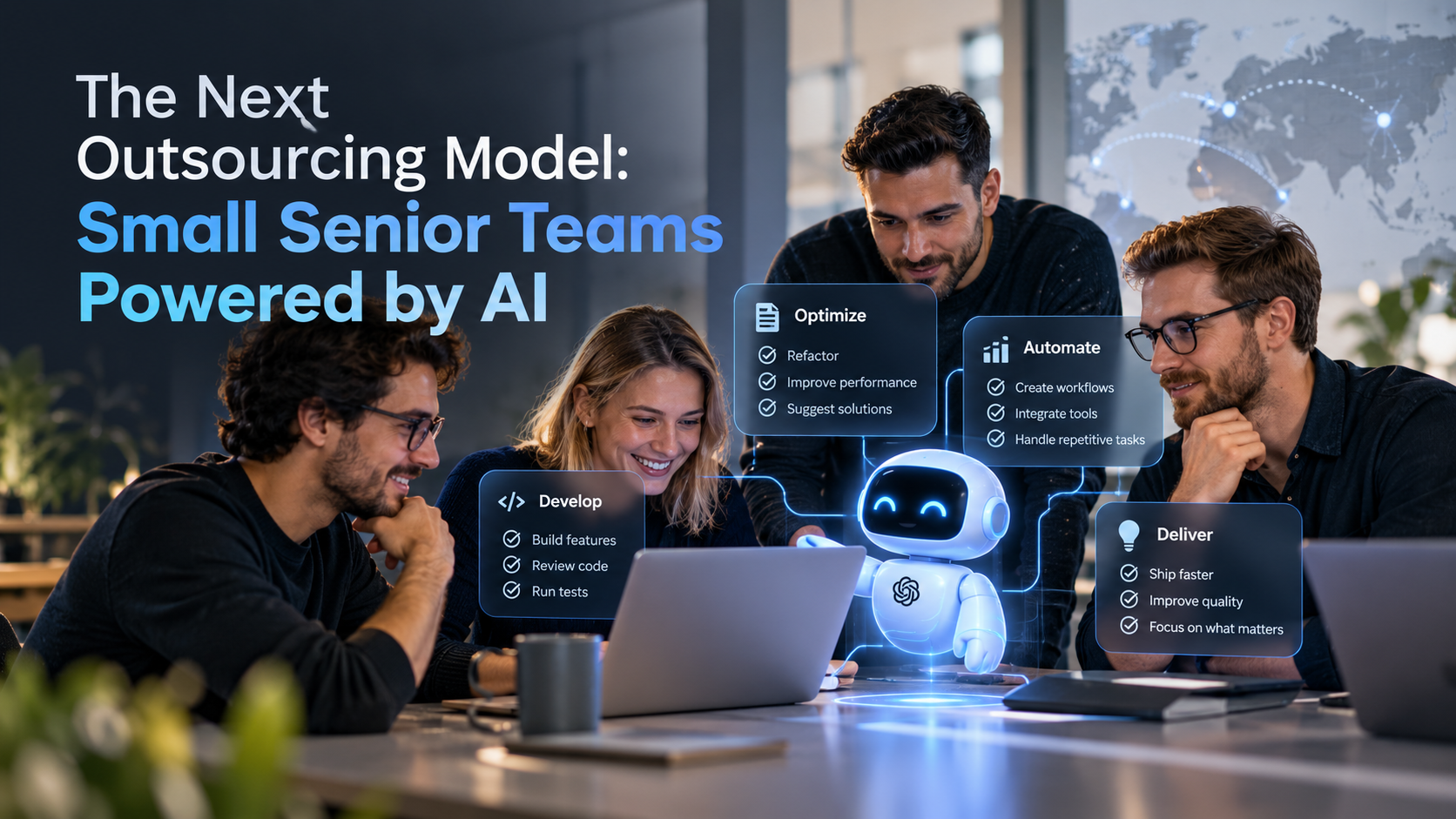
The Next Outsourcing Model: Small Senior Teams Powered by AI
19 May 2026
For years, software outsourcing followed a familiar model: the bigger the project, the bigger the team.
A complex digital product might require developers, QA engineers, business analysts, DevOps specialists, designers, and project managers working together for months or even years.
That model is starting to change.
AI coding assistants, automation tools, and AI agents are reshaping how software teams work. The result is not necessarily fewer software projects or less demand for engineering. Instead, companies can increasingly achieve more with smaller, more experienced teams supported by AI.
This could become one of the most important shifts in the outsourcing market.
AI is increasing the productivity of experienced developers
Modern software development already involves much more than writing code manually.
Developers use frameworks, libraries, cloud platforms, APIs, CI/CD pipelines, and automation tools to build products faster. AI is becoming another productivity layer in that toolset.
Senior engineers can now use AI to accelerate tasks such as:
- generating boilerplate code;
- creating tests;
- reviewing code;
- writing technical documentation;
- analysing unfamiliar codebases;
- debugging issues;
- generating SQL queries;
- creating API integrations;
- refactoring existing functionality.
These capabilities do not remove the need for engineering expertise.
In many cases, they increase the value of experience.
AI can generate code quickly, but someone still needs to understand architecture, security, scalability, business requirements, system dependencies, and the consequences of technical decisions.
The more powerful the tools become, the more important it becomes to have experienced people directing them.
Smaller teams can cover more ground
Traditionally, companies often expanded development capacity by adding more developers.
With AI-assisted development, the equation may begin to look different.
A small group of strong senior engineers can potentially handle work that previously required a larger team.
Instead of assigning separate people to repetitive documentation, basic code generation, simple testing, and technical research, AI tools can support those activities while engineers focus on the areas where human judgment matters most.
This does not mean that every ten-person development team can suddenly become a three-person team.
Software projects still require different skills, and complexity does not disappear.
But the productivity of individual team members can increase.
For outsourcing clients, that changes how projects can be structured.
The question may increasingly become:
How small can the team be while still having all the senior capabilities needed to deliver successfully?
Seniority becomes more important, not less
AI works best when the person using it can evaluate the output.
A less experienced developer may be able to generate code faster with AI, but may not always recognise architectural problems, security risks, unnecessary complexity, or poor long-term design choices.
Senior engineers are better positioned to use AI as a productivity multiplier.
They understand when generated code is good enough, when it needs modification, and when the entire approach should be reconsidered.
This creates an interesting shift in outsourcing economics.
Instead of building large teams with a broad pyramid of junior and mid-level developers, some projects may benefit from smaller teams consisting primarily of senior specialists.
The hourly rate may be higher, but the total delivery cost can still be competitive if fewer people are required and development cycles become shorter.
AI does not remove the need for collaboration
Software development is not only about coding.
Understanding business requirements, challenging assumptions, designing the right architecture, and coordinating with stakeholders remain human responsibilities.
A successful development team still needs to communicate with the client, understand priorities, and make trade-offs.
AI can support these activities by summarising meetings, preparing documentation, analysing requirements, searching internal knowledge, or drafting technical proposals.
But it does not replace the relationship between the client and the people responsible for delivering the product.
This is why the future outsourcing model is unlikely to be simply:
“AI builds the software.”
A more realistic model is:
Experienced engineers build the software, while AI helps them work faster and reduce repetitive work.
The outsourcing industry may move from selling capacity to selling outcomes
Traditional outsourcing has often been based on capacity.
Clients buy a certain number of developers for a certain number of hours.
But if AI increases productivity, the value of an outsourcing partner becomes less connected to the number of people assigned to a project.
Clients ultimately care about results.
They want software delivered faster, problems solved, systems improved, and business goals achieved.
This means outsourcing providers may increasingly compete based on their ability to combine senior engineering talent, domain knowledge, AI tools, and efficient delivery processes.
The strongest teams will not necessarily be the largest ones.
They may be the teams that understand the problem quickly, make strong technical decisions, and use AI to execute faster.
A new type of development team
AI is unlikely to eliminate software outsourcing.
It is more likely to change its structure.
Instead of large teams performing every task manually, companies may increasingly work with small, highly experienced teams supported by AI-powered development tools and automation.
Different projects will still require different team sizes and skill sets. Some complex programmes will continue to need large multidisciplinary teams.
But one direction is becoming clearer.
In the next generation of software outsourcing, productivity may depend less on how many developers are assigned to a project — and more on how effectively the team combines human expertise with AI.

